



If the Microsoft Teams notification sound now triggers a tiny amount of PTSD, especially when you know it probably means an unexpected call, you’re in good company.
Teams has become one of those tools most people already know, whether they use it every day or simply recognize it as one of the default options for workplace communication. Microsoft reported 270 million Microsoft Teams users in 2022, which gives you an idea of how deeply it has made its way into the workplace.
But familiarity doesn’t necessarily mean it’s the right fit for every team.
For some companies, Teams makes perfect sense. It fits comfortably into the Microsoft ecosystem they already use. For others, the combination of channels, meetings, apps, files, and notifications can start to feel like more software than the team actually needs. And sometimes the reason is much simpler. You’re comparing collaboration software and want to know what exists beyond the two names everyone already knows, Teams and Slack.
That’s why looking for Microsoft Teams alternatives can mean very different things.
Maybe you want a simpler team chat. Maybe you need stronger project management or a task manager that connects everyday conversations with actual work. Maybe video conferencing is your priority, or you need a business phone system. Or perhaps you’re simply comparing different team collaboration tools to understand which ones bring communication, project coordination, and everyday work together in a way that suits your team.
The point isn’t that everyone should leave Microsoft Teams. It’s that different teams have different reasons for looking elsewhere.
This guide covers nine options, plus one specialist tool for custom communication. Each takes a different approach, so instead of simply listing features, we’ll look at the kind of work you might use each one for, what to test, and what you may still need alongside it.
10 Microsoft Teams alternatives
- Chanty is a streamlined alternative to Microsoft Teams, offering team chat, task management, and audio/video calling in a simple, easy-to-use interface perfect for small to mid-sized teams.
- 8×8 replaces Microsoft Teams by providing an all-in-one business communication platform with integrated voice, video, chat, and contact center features for unified team collaboration.
- Zoho Connect serves as a Teams alternative by combining social intranet features with group chat, file sharing, and task management tailored for internal collaboration.
- Nifty offers a project-focused alternative for Teams, integrating communication with project milestones, timelines, and team collaboration in a single workspace.
- Mattermost is a self-hosted alternative to Teams ideal for privacy-focused or technical teams, offering secure messaging, file sharing, and developer-friendly integrations.
- Zoom can substitute Microsoft Teams for businesses focused on reliable video conferencing, with chat, webinars, and integrations rounding out its collaboration suite.
- Cisco Webex is a robust enterprise-grade alternative to Teams, delivering secure video meetings, team messaging, and calling with advanced admin and compliance controls.
- Salesforce Chatter can replace Teams in Salesforce-driven environments by enabling collaboration through feeds, file sharing, and updates directly within the CRM.
- Twist offers an asynchronous communication alternative to Teams, minimizing distractions with organized threads instead of real-time chat for focused team collaboration.
- Twilio is a developer-first alternative to Teams, allowing businesses to build custom communication workflows including messaging, calls, and notifications tailored to their exact needs.
Why look for a Microsoft Teams alternative?
You don’t need to be unhappy with Teams to compare your options. Start with the work your team needs to do, then identify where your current or proposed setup falls short.
You want a workspace employees can use comfortably
Can a new employee find the right conversation? Can someone working away from a desk catch up on an update? Does a manager know where to post a request?
If you already use Teams, separate problems with the software from problems with the way it has been organized. Duplicate channels and unclear posting habits can follow you into another app.
This also depends on how your team prefers to communicate. Some tasks benefit from quick, real-time exchanges, while others don’t require everyone to be available at once. Understanding the difference between synchronous and asynchronous communication can help you decide what kind of workspace makes sense.
You need clearer follow-up after conversations
“Can someone update the pricing page by Friday?” is a reasonable request. It becomes a problem when nobody knows who owns it or where to check progress.
Teams can support tasks through Planner, so task management alone isn’t a reason to leave. Compare how employees create, find, discuss, and complete work in each setup.
If another platform handles that workflow more naturally for your team, that is a more meaningful reason to consider switching than simply having “tasks” on the feature list.
Your existing tools already cover part of the job
If you already have project software, file storage, and a CRM that people use successfully, another broad suite may introduce duplication.
On the other hand, consolidating a few everyday workflows may be useful if employees currently move between several apps to handle a simple request.
Map the proposed setup before deciding. The cheapest or most feature-rich platform isn’t necessarily the one that creates the least friction.
You have specific meeting, calling, or deployment requirements
External meetings, business phone numbers, self-hosting, and asynchronous discussions lead to very different shortlists. Identify requirements that could rule a product out before spending time comparing minor features.
For example, a company that needs to manage teams with different backgrounds, locations, schedules, and levels of technical comfort may prioritize usability and access differently from a technical team that needs control over deployment.
Best Microsoft Teams alternatives: Quick comparison
| App | Shortlist it for | Important consideration |
|---|---|---|
| Chanty | Staff chat, calls, and everyday task coordination | Check your project planning and integration requirements |
| 8X8 | Business calling alongside employee communication | Define the phone, contact-center, and collaboration services you need |
| Zoho Connect | Internal updates, employee communities, and shared knowledge | An intranet-style workspace serves a different purpose from fast-moving chat |
| Nifty | Projects, milestones, tasks, and related discussions | Your wider meeting and staff communication needs still matter |
| Mattermost | Self-hosted communication and deployment control | Include operation and maintenance in the decision |
| Zoom | Meetings with ongoing messaging and task capabilities | Compare the products and features in your selected plan |
| Cisco Webex | Meetings, calling, messaging, and communication infrastructure | Confirm the scope and licensing of the proposed setup |
| Salesforce Chatter | Collaboration around Salesforce records | Its usefulness depends on employees’ Salesforce workflows and access |
| Twist | Threaded, asynchronous discussions | Establish how urgent contact and live meetings will work |
| Twilio | Building custom messaging and calling workflows | Requires development and ongoing maintenance rather than ready-to-use setup |
These are different kinds of alternatives. Some can cover a broad communication workflow. Others address a particular part of what you currently do in Teams.
Chanty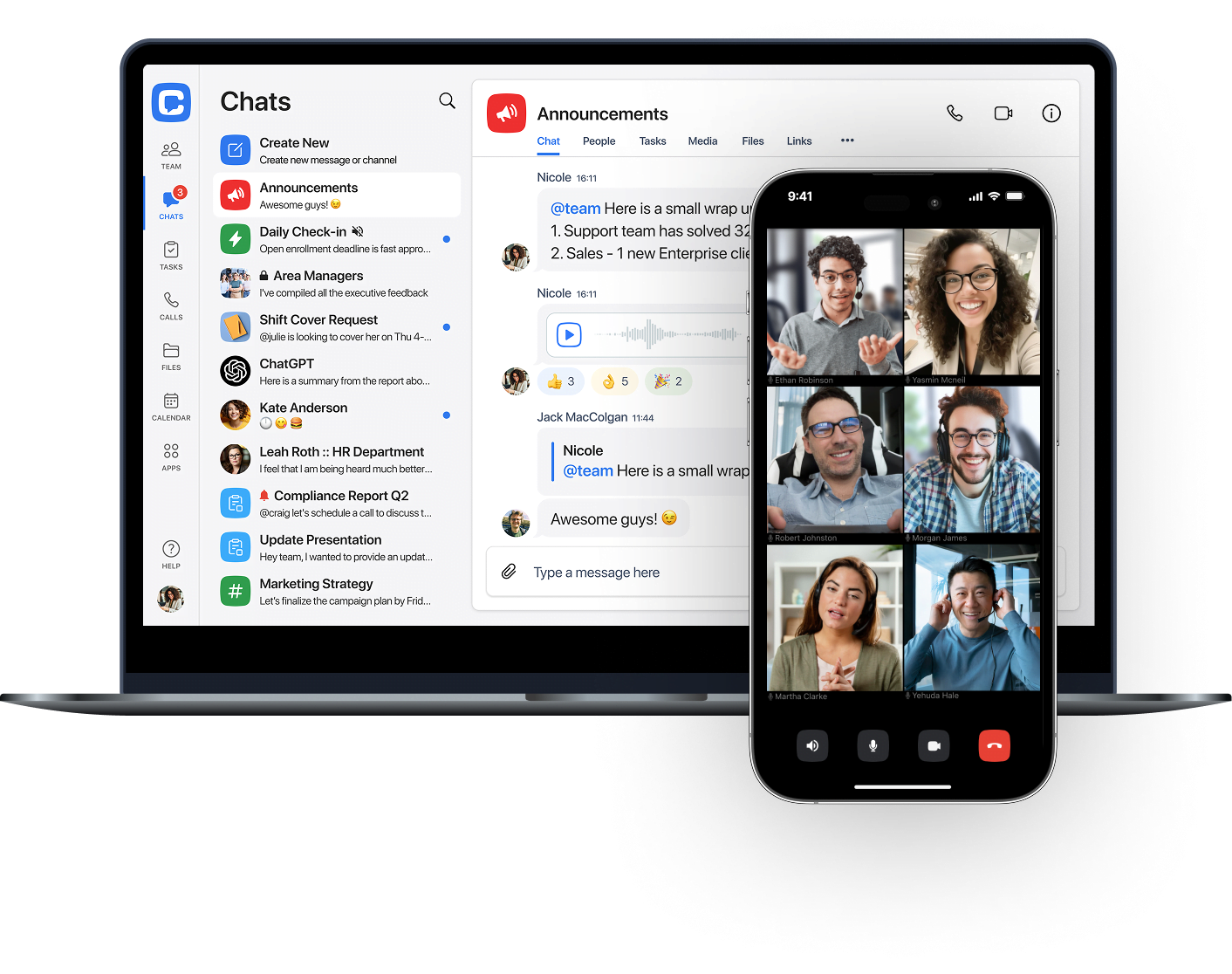 |
Chanty combines messaging, audio and video calls, file sharing, and task management. You can create tasks from messages, assign them, track their status, and discuss them in a related flow. The task area in Teambook helps you find and manage assigned work.
Imagine an operations manager asking a colleague to check supplier pricing and update a shared document.
The message becomes an assigned task rather than remaining a request people have to remember. A Kanban view provides another way to follow the work.
That makes Chanty relevant when you want everyday conversations and straightforward coordination in the same place.
It doesn’t establish that Chanty will be easier than your existing Teams setup. Teams supports comparable task workflows, so the useful comparison is what happens when both teams handle the same request.
What matters when comparing it:
- Communication: Messaging, calls, and shared files sit alongside tasks in the workspace.
- Follow-up: Message-to-task creation, assignment, status tracking, and related discussion support routine requests.
- Visibility: Check how task visibility works for public and private conversations and whether it matches your team’s needs.
- Scope: Detailed project scheduling, document editing, and specialist integrations deserve separate evaluation.
Try this: Have one person create a request, another take ownership, and a manager find its status later. Include mobile users and check whether the right people can see the task and supporting information.
Chanty offers Free and paid plans. Compare the relevant limits and features on the pricing page.
8X8

8×8 belongs on the shortlist as a best MS teams alternative when communication means more than employee chat. Its offerings include business calling, messaging, meetings, and contact-center services. The specific combination depends on the products you select, but it’s worth understanding how features such as call routing, extensions, voicemail, and call management fit into a business phone system before comparing providers.
Consider a service business whose employees answer customer calls throughout the day. It needs company numbers, call routing, transfers, and voicemail alongside internal communication.
Choosing another chat app would address only part of that requirement.
8×8 can also work alongside Teams. Its Teams integration supports calling-related workflows, so improving the phone setup doesn’t necessarily mean moving staff conversations elsewhere.
This is important when evaluating alternatives. Sometimes the right answer isn’t replacing Teams at all. It may be adding a stronger communications layer around it.
What matters when comparing it:
- Business calling: Evaluate numbers, routing, queues, transfers, and voicemail for your actual locations.
- Contact center: Treat agent workflows as a separate requirement from ordinary employee calling.
- Teams coexistence: Decide whether you want a replacement platform or additional services around Teams.
- Customer communication: Compare how internal communication connects with customer-facing work, especially if you’re also considering customer service software like Hiver.
- Licensing: Ask for the complete proposed configuration, including retained Microsoft licenses and implementation.
Try this: Call the business number while the usual recipient is unavailable. Follow the call through routing, transfer, and voicemail, then check what the employee and administrator can see afterward.
If your team mainly needs internal messages and occasional calls, this broader phone-system evaluation may be unnecessary. For a calling-heavy business, it is central to the choice.
Zoho Connect
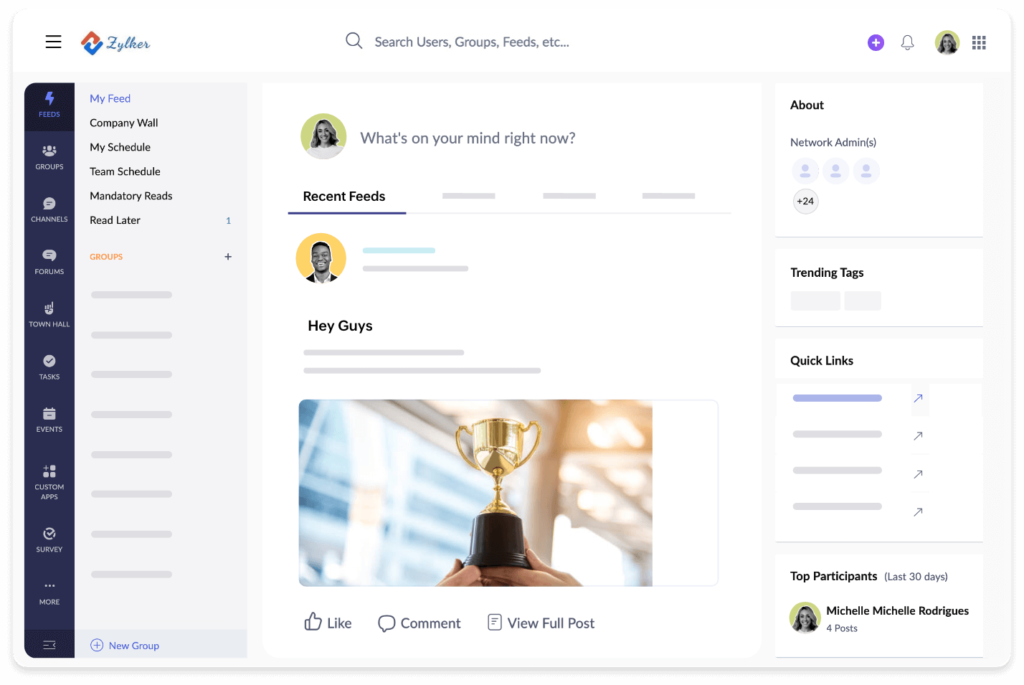
Zoho Connect takes an intranet and employee-community approach. Company information, group discussions, shared knowledge, and employee engagement are part of its purpose.
That makes it relevant when the problem is keeping information accessible beyond the moment it is posted.
A policy update, company announcement, or useful departmental discussion may need a longer life than a quick exchange in chat.
Imagine an organization introducing a new expense policy. Employees need to find the current guidance, understand what changed, and ask questions.
During evaluation, follow that information from publication through later discovery by someone who missed the original update.
What matters when comparing it:
- Information structure: Consider where announcements, reference material, and discussions will live.
- Employee communities: Groups can serve a different purpose from a channel used mainly for quick exchanges.
- Zoho connections: Existing Zoho use is a reason to investigate. Verify the particular integrations and permissions you need.
- Communication coverage: Establish how the proposed setup handles immediate contact and meetings.
Try this: Ask a colleague returning from leave to find the latest policy, identify the relevant change, and ask a question without help from the person who published it.
Nifty

Nifty brings tasks, milestones, project discussions, and documents into a project-centered workspace. It is an option when knowing where work stands matters as much as communicating about it. This is particularly relevant for teams comparing project management tools, since not every platform handles planning, task dependencies, and team communication in the same way.
A marketing team preparing a launch, for example, has content, design, approvals, and deadlines to coordinate.
Another chat channel provides somewhere to talk, but it doesn’t necessarily provide a useful overview of delivery.
A project workspace gives you a different structure to evaluate. Can colleagues see the work, understand its progress, and find related discussions without reconstructing the project from messages?
What matters when comparing it:
- Project management: Tasks and milestones provide a framework for organizing delivery.
- Related context: Evaluate how discussions and documents remain connected to the work.
- Planning depth: Test your actual scheduling and reporting requirements rather than treating all project features as equivalent.
- Wider communication: Include company updates, informal staff contact, and external meetings in your assessment.
Try this: Change a launch deadline during the trial. Ask the team to identify affected work, update responsibilities, and locate the conversation explaining the change. Verify which parts are supported directly and which require manual coordination.
Nifty may replace project coordination that currently happens around Teams. Whether it also replaces your wider communication setup depends on your requirements.
Mattermost

Mattermost offers self-hosted collaboration and focuses on controlled operational environments, including technical and security-related workflows. Deployment requirements can therefore be a starting point for evaluating it.
Imagine an infrastructure team coordinating an operational incident. Its requirements may include where communication runs, how access is controlled, and how the system connects to the team’s existing tools.
Those requirements are more specific than simply wanting another place to chat.
But infrastructure fit is only half the evaluation. Employees still need to find conversations, manage notifications, and understand what happened while they were away.
What matters when comparing it:
- Deployment: Confirm the hosting model and edition that meet your requirements.
- Operational fit: Evaluate relevant integrations and the way responders share context.
- Ownership: Self-hosting requires responsibility for updates, backups, monitoring, availability, and support.
- User experience: Include search, notifications, mobile access, and onboarding in the trial.
Try this: Use a simulated operational issue to test the communication workflow. Separately, have the technical owner review deployment, recovery, and ongoing support requirements.
Self-hosting gives you responsibility as well as control. Include staff time and infrastructure in the total cost, alongside the subscription.
Zoom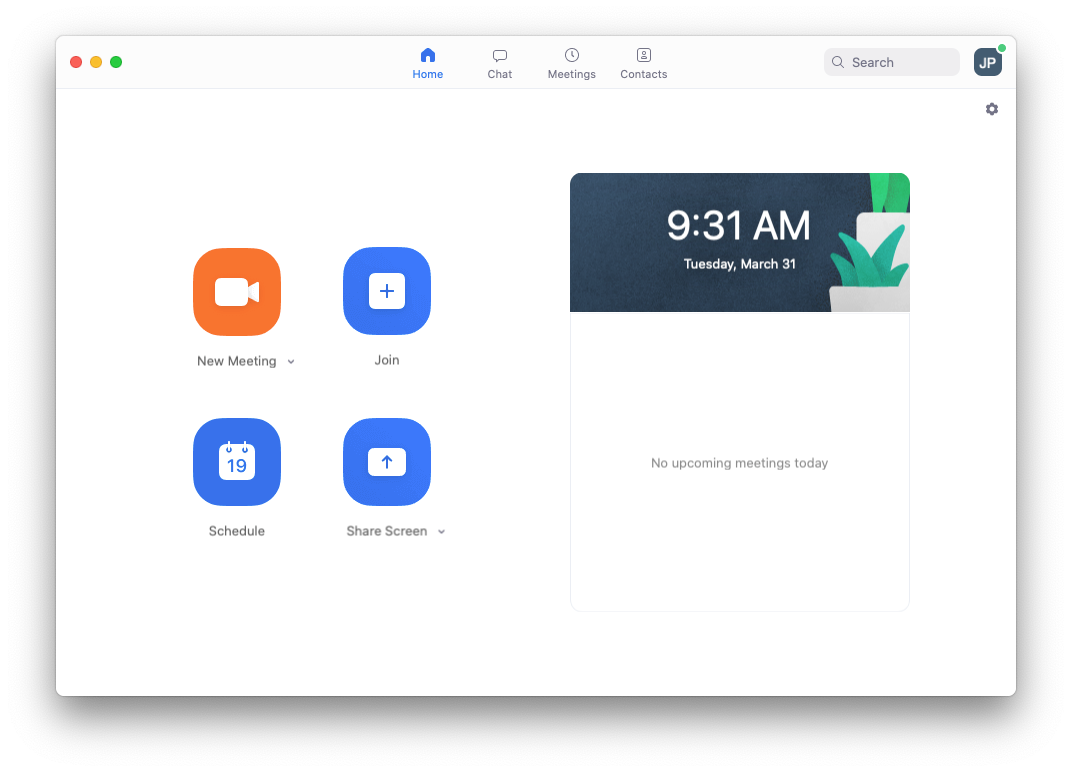 |
Zoom Workplace extends beyond video meetings. It includes ongoing team chat, and Zoom Tasks supports creating and managing action items, including from chat. If meetings are central to your team’s workflow, it’s worth looking beyond call quality and considering features such as screen sharing, recording, participant management, and integrations. These are some of the capabilities that distinguish different video conferencing solutions. Product access and capabilities depend on the selected setup.
That makes Zoom relevant when meetings are already a familiar part of the team’s working day.
The evaluation should include what happens before and afterward, rather than stopping at the call experience.
For a client-facing team, that might mean sharing an agenda, running the meeting, assigning follow-up work, and keeping decisions accessible to colleagues who couldn’t attend.
What matters when comparing it:
- Meetings: Match participant access, duration, recording, and administration to the selected plan.
- Persistent conversation: Assess whether chat supports the team’s work between calls.
- Tasks: Test creation, ownership, progress, and available views directly.
- Synchronous communication: Consider how much of your team’s work genuinely needs to happen in real time.
- Complete setup: Distinguish included capabilities from additional products or licenses.
Try this: Run a sample client meeting, capture a follow-up action, and ask someone who missed the call to find the decision and its owner. Evaluate both the meeting experience and the effort required afterward.
A familiar meeting app may be a useful starting point, but employees should also try its wider workspace before you replace their existing communication tool.
Cisco Webex

The Webex suite covers meetings, messaging, calling, webinars, and other communication capabilities. It is relevant when your proposed setup includes several of those requirements.
For example, a company may need office meeting rooms, remote employees, external participants, and business calling to work together.
That is a different evaluation from selecting an app for a small group’s daily messages.
Existing Cisco infrastructure may also be relevant, but it should lead to a concrete compatibility assessment rather than an assumption that everything will connect automatically.
What matters when comparing it:
- Meeting environments: Test room-based, remote, and external participation.
- Calling and messaging: Define the employee workflows you expect the proposed setup to cover.
- Product boundaries: A capability or capacity advertised for one Webex product may not apply to another.
- Administration: Include setup, ongoing management, and employee onboarding in the comparison.
Try this: Hold a meeting with an office room, a remote employee, and an external guest. Test joining, sharing content, finding the follow-up discussion, and getting help when something goes wrong.
If your main reason for leaving Teams is complexity, compare the actual experience carefully. Another broad communications environment may fit better, but its breadth alone doesn’t demonstrate that.
Salesforce Chatter

Chatter supports collaboration within Salesforce through feeds, groups, and discussions associated with records. It is a specialist option when the information people need to discuss already lives in Salesforce.
For example, sales and support may need to discuss a customer account. Keeping that exchange near the record can preserve useful context and reduce the need to copy details elsewhere.
The question is how much of your organization’s communication follows that pattern.
Collaboration around customer records may suit one department while leaving other employees needing a broader workspace.
What matters when comparing it:
- Record context: Assess discussions around the accounts or other records your team actually uses.
- Access: Verify that participants can see the relevant information and conversation.
- Department coverage: Include colleagues whose work happens outside Salesforce.
- Replacement scope: Evaluate calling, meetings, and general staff communication separately.
Try this: Have sales and support discuss a sample account, then include a colleague from another department. Check access, context, and whether anyone needs a separate tool to participate in the wider workflow.
Chatter may replace some discussions currently held in Teams. That doesn’t automatically make it a complete communication replacement.
Twist

Twist organizes communication through topic-based threads and channels, with an inbox for following relevant discussions. It also supports private messages.
The appeal is a workspace where a discussion doesn’t depend on everyone responding immediately.
A proposal, review, or decision can remain organized around its subject while colleagues contribute at different times.
Imagine a distributed design team discussing a new onboarding flow. One person posts a proposal, others respond during their working hours, and the team records the decision in the discussion.
The useful test is whether someone joining later can understand the outcome without asking for a separate recap.
What matters when comparing it:
- Discussion structure: Threads help keep contributions organized by topic.
- Catching up: Evaluate the inbox and how people follow relevant conversations.
- Working habits: Agree on response expectations and who records final decisions.
- Urgency and meetings: Establish a separate path for immediate contact and confirm your live-call setup.
Try this: Discuss a proposal across two time zones without scheduling a meeting. Ask a colleague to find the final decision several days later.
An asynchronous app can support fewer interruptions, but the team’s habits matter too. If every thread triggers an expectation of an immediate reply, the software change won’t solve that problem by itself.
Twilio

Twilio takes a different approach from the ready-to-use collaboration apps on this list. It provides communication services and APIs that developers can use to build messaging, voice, video, and other communication experiences into their own software.
Imagine a service business that wants customers to receive appointment notifications and contact staff through a custom application. Rather than asking everyone to join a team workspace, the business needs communication built into an existing process. That is the kind of requirement that makes Twilio relevant.
The flexibility comes with a different buying decision. You are choosing components for a system your organization will build and operate, so the interface, access controls, and employee experience need their own design and implementation.
What matters when comparing it:
- Customization: Communication can be built around a specific application or workflow.
- Development: Budget for building, testing, maintaining, and supporting the resulting system.
- Cost: Estimate the selected services and expected usage alongside development and operational costs.
- Replacement scope: Twilio does not give employees a complete Teams-style workspace simply by creating an account.
Try this: Have your technical team prototype one narrowly defined workflow, such as an appointment notification and response. Evaluate delivery, failure handling, access requirements, and who will support it after launch.
How to compare your shortlist
Choose two or three relevant options and run the same work through each. Include Teams if you already use it.
You can start with a request such as “Update the pricing page by Friday,” but choose other examples if tasks aren’t your main requirement. A customer call, company announcement, or asynchronous review may tell you more.
The type of work matters here, too. For example, customer-facing teams may need more than internal messaging and calls. They might also rely on ticket management, shared inboxes, customer histories, and response tracking. In that case, customer service software may be a more relevant category to evaluate alongside general collaboration tools.
| Evaluation area | What to observe |
|---|---|
| Ownership | Can employees see who is responsible and what happens next? |
| Context | Can someone find the relevant conversation, decision, and files? |
| Progress | Can the team follow the work without repeatedly asking for updates? |
| Access | Can mobile users, guests, and other required participants do their part? |
| Additional software | Which steps need another app, license, or manual process? |
| Administration | Who sets up the workflow and supports it afterward? |
The point is to test the workflow, not just the feature.
A tool can have chat, tasks, calls, and files on paper while still making your team’s everyday work harder.
Record the configuration and plan you tested. A capability available in one edition may not be included in the subscription you intend to buy.
Already using Teams? Plan what changes
Switching collaboration platforms is not just a matter of importing users and sending everyone a new login.
Before migrating, list the workflows your team relies on, including the less visible ones: guest access, recurring meetings, notifications, permissions, shared links, and account management.
Then decide how each will work in the proposed setup.
- History and files: Confirm what can move and what must remain accessible elsewhere. Don’t assume messages, attachments, permissions, and links transfer together.
- Microsoft dependencies: Check document access, calendars, storage, identity, and any connected workflows you plan to retain.
- External collaboration: Test real guest scenarios, including joining meetings and accessing shared information.
- Administration and security: Evaluate access removal, required controls, and any contractual obligations for your intended use.
- Employee habits: Give people enough time to test the new workflow. A technically successful migration can still fail if nobody understands where work belongs.
You can keep Microsoft 365 while choosing another communication app. But retaining those subscriptions changes the financial case for switching.
It’s worth checking which Microsoft Teams plan you’re currently paying for, too. Features and limits differ between subscriptions, so reviewing what Microsoft Teams costs and includes at each pricing tier can help you distinguish between a genuine product limitation and a feature that’s simply unavailable on your current plan.
Compare the complete cost
A lower chat subscription doesn’t necessarily produce a cheaper setup. For an independent reference point, you can also check PCMag’s selection of the best business messaging apps to compare how different products approach workplace communication.
Microsoft Teams pricing is only one part of the comparison. Look at the services your team actually uses and what the replacement would require to cover them.
For a defined team size, include:
- The communication subscription and required plan upgrades
- Separate meeting, phone, project, or storage services
- Existing Microsoft subscriptions you will keep
- Integration and automation costs
- Implementation and migration
- Training and employee onboarding
- Ongoing administration and support
Compare the same billing period and requirements.
If you don’t yet know whether an additional service is necessary, include that question in the pilot rather than assuming the cost disappears.
Test a small change before making a large one
You don’t need to migrate the whole company to find out whether an alternative works.
Choose one team with representative work. Agree on a few tasks to perform and the result you want to improve.
For example, measure whether employees can find a decision without help, whether ownership is clear, or how often a request needs a status reminder.
Observe where people return to another app and why. Include what gets worse.
An alternative may improve one workflow while making another harder. The pilot should help you decide whether the overall change is worthwhile, including the effort of moving.
Choose around the work your team needs to do
A project team, a calling-heavy business, and an organization with self-hosting requirements need different shortlists.
Start with those requirements, then compare the everyday experience and complete setup.
If you want staff conversations and routine task coordination together, try Chanty. Bring a real request into the workspace, assign it, discuss the details, and follow its progress. That gives your team something practical to judge before committing.
If your existing Teams setup handles the same work well, keeping it may be the right decision.
A worthwhile alternative should give your team a clear improvement it can recognize in daily use.
Frequently asked questions
What is the best Microsoft Teams alternative?
The best Microsoft Teams alternative depends on your needs. Chanty is a strong choice for teams that want built-in task management and communication in one app, while Zoom excels at video conferencing, Mattermost focuses on security and self-hosting, and Twist is designed for asynchronous communication.
Why do companies switch from Microsoft Teams?
Many companies switch from Microsoft Teams because they want a simpler interface, more flexible pricing, stronger project management features, or a platform that isn’t tied to the Microsoft 365 ecosystem.
Is there a free alternative to Microsoft Teams?
Yes. Several alternatives offer free plans, including Chanty, Zoom, Mattermost, Twist, Nifty, and Cisco Webex. However, available features, storage limits, and user caps vary between platforms.
Which Microsoft Teams alternative is best for small businesses?
Small businesses often choose Chanty because it combines team chat, video calls, task management, and integrations in a single affordable platform. Zoho Connect and Nifty are also popular options for growing teams.
What is the best Microsoft Teams alternative for video conferencing?
Zoom and Cisco Webex are among the strongest alternatives for video meetings. Both support large-scale conferences, screen sharing, recordings, and advanced meeting controls.
Which Microsoft Teams alternative offers built-in project management?
Chanty, Nifty, Mattermost, Zoho Connect, and 8×8 include project or task management features. Chanty and Nifty place a particularly strong emphasis on combining collaboration and project tracking in one workspace.
Are there self-hosted alternatives to Microsoft Teams?
Yes. Mattermost is one of the most popular self-hosted Microsoft Teams alternatives. It gives organizations full control over their data, security settings, and deployment environment.
Which Microsoft Teams alternative is best for remote teams?
Remote teams often prefer Chanty, Zoom, or Twist. Chanty supports real-time collaboration and task management, Zoom focuses on meetings, and Twist helps distributed teams reduce interruptions through threaded conversations.
Can I use a Microsoft Teams alternative without Microsoft 365?
Absolutely. Most Microsoft Teams alternatives work independently and don’t require a Microsoft 365 subscription. This makes them a good fit for businesses that use Google Workspace, Zoho, Salesforce, or other software ecosystems.
What should I look for in a Microsoft Teams alternative?
When evaluating alternatives, consider your team’s communication style, video conferencing needs, task management requirements, integrations, security standards, ease of use, and overall pricing. The best platform should support your existing workflow rather than force you to change it.






Add comment